
Celebrating outstanding sustainability efforts across the global flavour & fragrance industry.
At the Closing Banquet of the IFEAT 2025 Göteborg Conference, delegates celebrated the winners of the first ever IFEAT Sustainability Awards – a milestone that puts sustainability at the heart of the F&F industry.
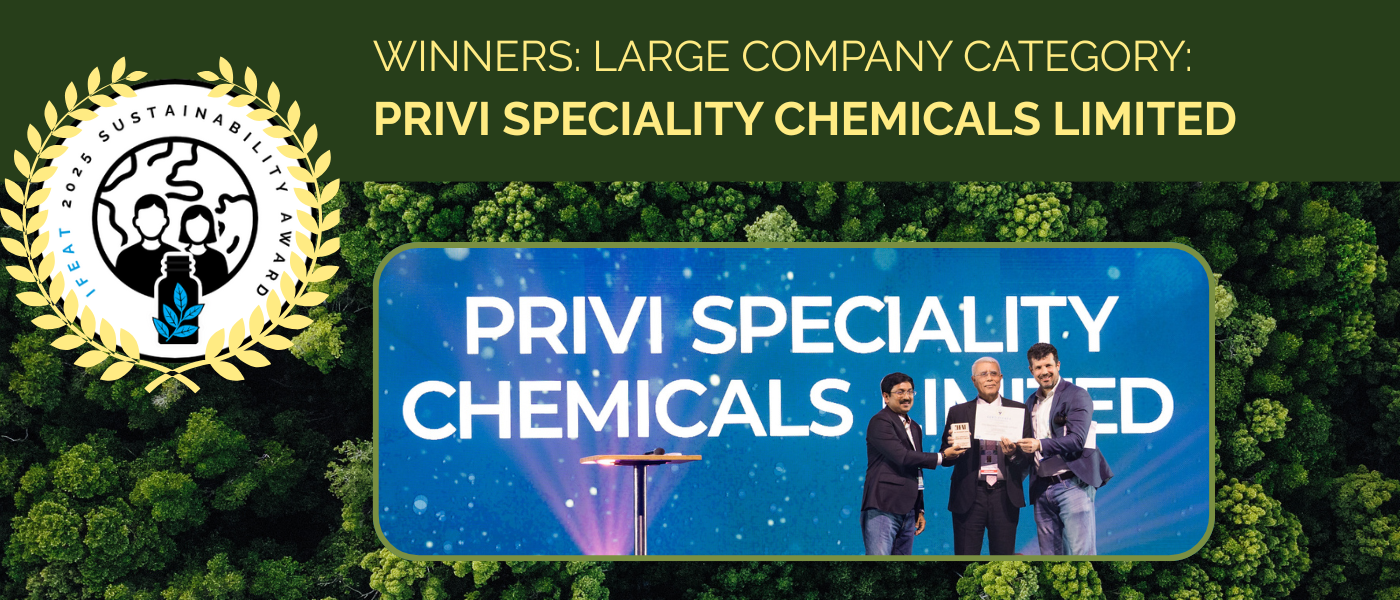
Privi Speciality Chemicals Limited, one of India’s leading aroma ingredient producers, was awarded 1st Prize in the Large Company category for its pioneering work in bio-based chemistry. The company has developed a process to convert bio-based sources into high-value aroma ingredients such as alpha- and beta-pinene or paracymene. Those bio-based sources are Crude Sulphated Turpentine (CST), an upcycled by-product of the pulp and paper industry that is often wasted or used in low-value applications, and Gum Turpentine Oil (GTO), a renewable feedstock from sustainably managed pine plantations.
This shift reduces reliance on petrochemicals while supporting FSC and RSPO certified forestry practices with impacts verified through ISO-compliant LCAs for major revenue-generating products.
The project also reinforces socio-economic responsibility through certified sourcing, supplier audits, and a strict code of conduct. Thanks to its significant processing capacity and robust business model, it demonstrates strong scalability and proves that bio-based chemistry can compete in a fossil-dominated sector without being tied to its price volatility. Finally, its strength in collaboration lies in partnerships across communities, suppliers, FMCGs, and researchers, embedding the initiative in a wider ecosystem of sustainable innovation.
As the company notes in its sustainability report, “sustainability is not a choice, it is a commitment… industrial innovation and environmental stewardship can go hand in hand — delivering products that are smarter, safer, and more sustainable”.
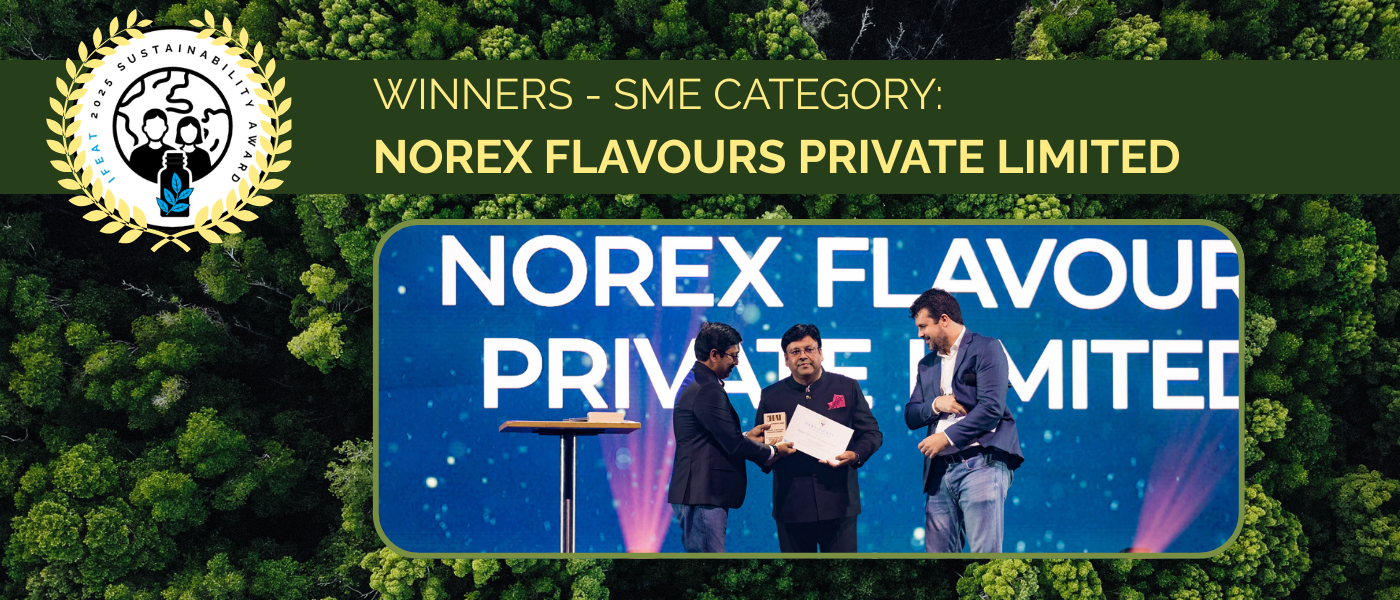
In Amroha, Uttar Pradesh, Norex Flavours Private Limited has redefined sustainability in the mint industry with Project Sankalp and is recognised as the winner in the SME category.
Working with 2,500 smallholder farmers across 100 villages, the initiative combines regenerative agriculture, digital innovation, and social empowerment into a scalable model.
At its core is Early Mint Technology (EMT), developed with CIMAP (Central Institute of Medicinal and Aromatic Plants), which shortens crop cycles by 30–50 days and reduces water use by approximately 30%. New practices cut chemical use by 70%, while upgraded distillation units have improved oil recovery by 15–20%.
These advances increased farmers’ incomes by nearly 50%, thanks to higher yields, intercropping, and direct links to buyers, proving that sustainability can drive prosperity.
Beyond the farm, over 100 training sessions have spread regenerative and Good Agricultural Practices, while women now lead cultivation and related enterprises, earning equal wages and gaining literacy and WaSH (Water, Sanitation, and Hygiene) program support.
A digital traceability app tracks inputs, yields, water, and carbon in real time, ensuring transparency for buyers and guiding farmers’ decisions.
Collaboration has been central – linking farmers, distillers, scientists, NGOs, and local governance. Together, they are building a blueprint for sustainable farming practices that can be replicated well beyond mint. Determined to build on these achievements, Norex is already charting the next phase of Sankalp’s journey: “The next phase will scale impact with ambitions to expand to 5,000 farmers and add two new crops (Piperita & Spearmint).”
About the Award
The IFEAT 2025 Sustainability Awards were launched in response to rising expectations from clients and regulators, the industry’s deep dependence on natural resources, and growing scrutiny over sourcing practices and petrochemical reliance. By recognising initiatives that combine innovation with responsibility, the Awards highlight solutions that help protect ecosystems, empower communities, and drive systemic change.
For this first edition, the response was remarkable: 40 applications were received from members across Asia, Europe, Africa, and North America, a powerful signal that the call for sustainability is truly universal.
How were applications scored?
To ensure fairness and credibility, each project was first evaluated using a scoring framework developed by Quantis, a leading sustainability consulting firm. The assessment is built on four pillars: environmental impact, socio-economic benefits, scalability, and collaboration. This method allowed for a balanced comparison across very different types of initiatives. Awards were given in two categories: one for SMEs and one for large companies, and the top-scoring projects were then reviewed by an expert panel convened by IFEAT.
What did we learn?
Beyond celebrating the winners, the first edition of the IFEAT 2025 Sustainability Awards offered a snapshot of the industry’s sustainability journey.
Mint cultivation featured prominently as a testing ground for more resilient and inclusive farming models, while regenerative practices showed how degraded land can be restored for long-term benefits. On the innovation side, bio-based chemistry emerged as a key theme, reducing reliance on petrochemicals, alongside eco-design and digital tools. While promising, these solutions also raised questions about accessibility and scalability, particularly for smaller enterprises.
As one member of the expert panel noted, ranking the many innovative applications was “like solving a 54-facet Rubik’s Cube: complex and multifaceted.” That complexity is a strength, showing that sustainability in our industry is advancing along multiple paths – farming, chemistry, and technology.
Award Categories
Awards were presented in two categories based on company size:
- Small and Medium Enterprises (1–250 employees)
- Large Companies (>250 employees)
Award Criteria
All applications were evaluated using a structured scoring framework by an independent panel of sustainability and industry experts.
The total score is distributed across four pillars:
1. Environmental Impact – 30%
We assessed whether the project addresses a real environmental hotspot in the flavour and fragrance industry. Key criteria include:
Does the initiative tackle a significant environmental challenge (e.g. climate, biodiversity, water, waste management)?
Is it a pioneering or best practices approach?
Are the results/ outcomes already tangible, measurable, and independently verified?
2. Socio-Economic Impact – 30%
We evaluated the project’s benefits to people – such as employment, livelihoods, or working conditions. Specifically:
Does the project address a clear socio-economic gap?
Is the approach innovative and leading?
Are the results documented, measured, and verifiable?
3. Scalability & Replicability – 30%
We considered the potential to grow or repeat the project in other places or parts of the business:
Are there major financial, technical, or knowledge barriers?
Can it be rolled out to more geographies or scaled within your organisation?
4. Sectoral Collaboration – 10%
We measure the breadth and depth of collaboration:
How broad and meaningful are the partnerships involved, if any?
What did the winners receive?
Winners of the IFEAT 2025 Sustainability Awards received:
- Two complimentary delegate tickets to the next IFEAT Conference.
- A dedicated one-page spotlight in an upcoming issue of IFEATWORLD, highlighting the winners’ contributions and achievements.
- Public recognition across IFEAT communication platforms, including social media, and official Conference materials.
- A customised award and certificate to celebrate their achievement.