

EDUCATION
IFEAT, in its continuing support of the industry, has provided the possibility for members to join learning programmes and studies on the many aspects of the essential oils and aroma trades.
Following the successful completion of the programmes, students are awarded the IFEAT Flavourist and Perfumery Diplomas.
Flavourist Course
IFEAT is supporting this programme of training modules which has been developed in association with the British Society of Flavourists. The Programme, held within the Department of Food and Nutritional Sciences at the University of Reading, will provide the foundation on which to build a career as a flavourist.
Full information and details of the next course will be posted on the university’s website: https://www.reading.ac.uk/food/shortcourses/foodbio-flavourist.aspx
If you require any further information, then please contact the Department on:
Tel: +44 (0) 118 378 8700, Fax: +44 (0) 118 931 0080 or email: [email protected]
Aroma Trades Studies (Perfumes and Flavours)
ICATS (The International Centre for Aroma Trades Studies) has been providing bespoke distance learning courses specifically designed for professionals in the global Aroma Trades industry (flavours and fragrances) for well over a decade.
Study on the ICATS programmes (which are aimed at postgraduate learners or those with industry experience) either leads to an industry-recognised full IFEAT Diploma in Aroma Trades Studies (Flavour or Fragrance), or certification for selected modules completed. Designed and written by world-leading industry experts it aims to suit all CPD needs within the Aroma Trades. All awards are validated by IFEAT and fully endorsed by The British Society of Perfumers, The British Society of Flavourists and IFRA UK.
A 20% discount is available to students representing IFEAT Member companies!
If you would like any further information, then please contact: Lindsay Smith, Education Officer: [email protected]
For information on this course, visit the course website at: www.icats.education
Download the ICATS Autumn 2019 newsletter
Download the ICATS Spring 2020 Newsletter
Download the ICATS Autumn 2020 Newsletter
Download the ICATS Summer 2021 Newsletter
Download the ICATS Winter 2021 Newsletter
Download the ICATS Summer 2022 Newsletter
ISEO Sponsorship
For many years now IFEAT has given financial support for the participation of 20 to 25 young scientists students at the annual International Symposium on Essential Oils (ISEO). This annual scientific meeting of researchers and industrialists is a globally recognised forum for information on new technologies and natural raw materials of interest to the Flavour and Fragrance industry, especially essential oils and other natural complex substances (NCS). The IFEAT grant enables some of the top students from around the world to attend and ISEO has acknowledged the benefits of IFEAT funding. The highly successful working cooperation between the two organisations has been further strengthened due to increased collaboration with sister industry associations as it is one of the focus areas for IFEAT’s Chief Scientific Officer, Jonathan Bonello, who has become a member of the ISEO Permanent Scientific Committee.
In recent years the ISEO has taken place as follows:
Lublin, Poland from 13 to 16 September 2015 – 150 participants from 34 countries ISEO 2015 REPORT
Nice, France from 11 to 14 September 2016
Pécs, Hungary from 10 to 13 September 2017 – 152 participants from 32 countries ISEO 2017 REPORT
Nis, Serbia from 13 to 16 September 2018 – 133 participants from 31 countries ISEO 2018 REPORT
Vienna, Austria from 9 to 11 September 2019 – over 200 participants mainly from Europe but also from Argentina, Brazil, Canada, China, Columbia, Guatemala, Iran, Israel, Japan, Mongolia, New Caledonia, South Africa, Taiwan, Turkey and the USA. ISEO2019_IFEAT_REPORT Acknowledgment IFEAT 2019
Online (replacing Nicosia, Cyprus) from 12 to 14 November 2021 – on the first day of the Symposium, Alain Frix (IFEAT’s Scientific Committee Chair) and Jonathan Bonello (IFEAT’s Chief Scientific Officer) gave a presentation on “Why are essential oils so important for the present and future renewability of the F&F industry?” during Session One and Jonathan Bonello co-chaired Session Two. IFEAT received the following acknowledgment of its support: Certificate of Appreciation 2021
Wroclaw, Poland from 4th to 7th September 2022 – the 51st ISEO https://iseo2022.pl/ Here’s a report on the ISEO 2022: ISEO 2022 Report
Milazzo, Messina, Italy from 13 to 16 September 2023 – the 53rd ISEO: https://www.iseoils.com/iseo2023 Here’s the final programme and book of abstracts for reference.
Balatonalmádi, Hungary from 8 to 11 September 2024 – the 54th ISEO: https://iseo2024.hu/index.php#about Again, IFEAT sponsored a group of young scientists to attend the event.
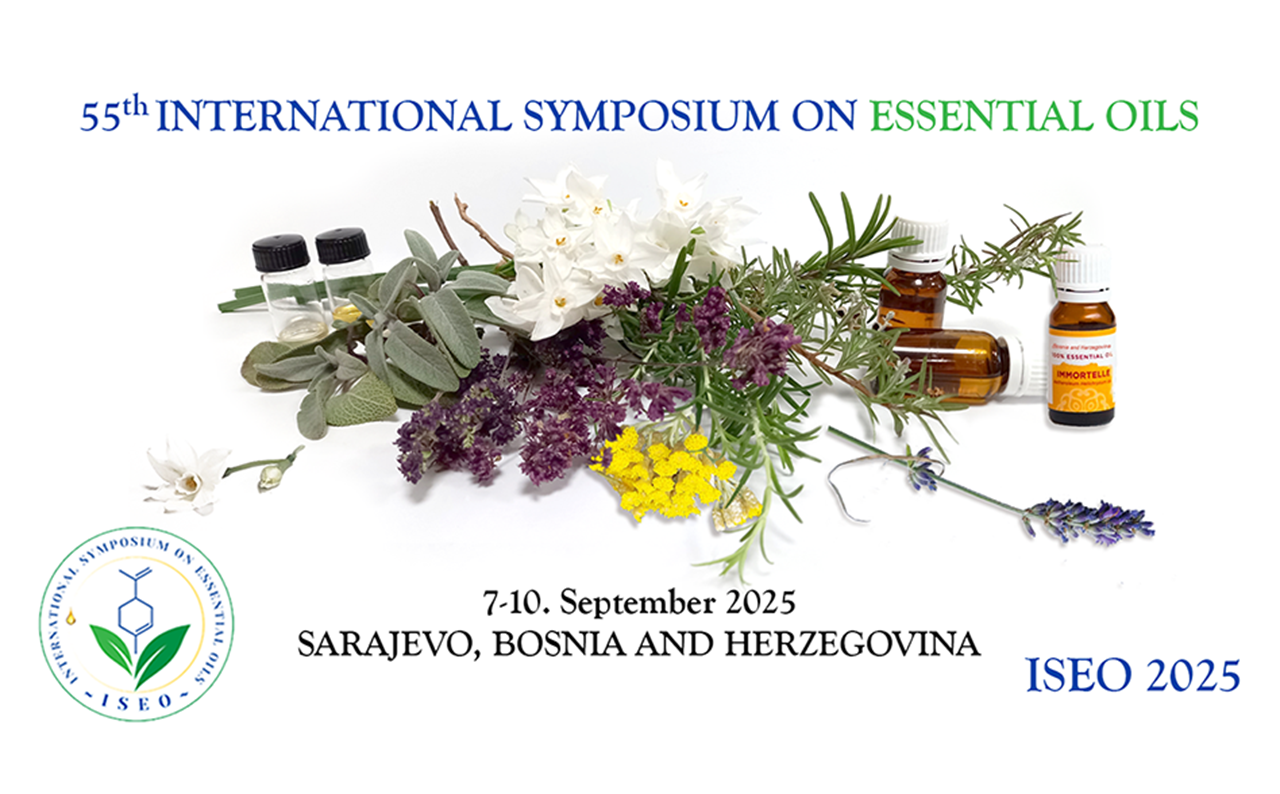
Sarajevo, Bosnia and Herzegovina, from 7 to 10 September 2025 – the 55th ISEO. https://www.iseoils.com/info-2025 Click the image below for information – The deadline for early registration is 15th June 2025. Please contact [email protected] with any questions.
WOCMAP Sponsorship
In 2019, IFEAT was also a proud sponsor of the 6th World Congress on Medicinal and Aromatic Plants (WOCMAP VI) which took place from 13-17 November 2019 in Famagusta, Northern Cyprus. IFEAT sponsored the registration fees of 10 young scientist and kindly received a certificate of thanks from WOCMAP.

INDUSTRY SUPPORT / IFEAT FUNDED PROJECTS
The services provided by the Federation continue to develop and expand. Together with the organisation of the annual Conferences and the Study Tours, IFEAT is investing finances and time on behalf of the global trade in essential oils and aroma chemicals, in the following areas:
1. RIFM Project
Based in New Jersey, USA, RIFM is an independent organisation whose primary function is the safety evaluation of fragrance materials, including the assessment of essential oils and Natural Complex Substances (NCSs). The objective of the project is to keep building a recognised database on the safety of NCSs that is accessible to IFEAT Members. The IFEAT Executive Committee believes this information will be invaluable in promoting the safe use of products to our governments, regulatory bodies and to the public in general.
The first phase of the project involved analysis of the genotoxicity endpoints and includes all three tests: BluescreenTM, AMES and in vitro micronucleus tests. Essentially, the sequence of tests aims to determine whether a given chemical can cause mutations in the DNA of the test organism. A total of 70 NCSs were submitted with samples received mostly through the IFEAT Executive Committee and IFEAT Members. Testing has been completed on 63 oils and all samples have negative results, meaning that the whole oil does not present a genotoxicity hazard under the test conditions and according to existing standards. Results are under review for Davana oil, Lovage root oil, Calamus oil, Savory summer oil, Parsley seed and leaf oils and Perilla oil.
Based on this successful project, and as a next step in strengthening mutual relations, RIFM and IFEAT signed a Memorandum of Agreement that will see IFEAT contributing financially to the continuing RIFM Safety Assessment of NCSs. A five-year programme was launched in 2021 and is expected to cover approximately 600 additional NCSs of relevance to IFEAT Members by 2027. The first expert panel and peer reviewed NCS safety assessment resulting from this work has been published by Elsevier and is available in the public domain (Petitgrain Mandarin Oil, CAS registry number 8014-17-3). All RIFM safety assessments, are available free of charge on the Elsevier site: https://fragrancematerialsafetyresource.elsevier.com/
A further 32 fragrance ingredient safety assessment manuscripts will be submitted to peer review and publication. These will include most of the remaining citrus family items from the first pass and other first round NCSs from the mints, pines and lavender families. Together these manuscripts will account for 43% in volume of the main items used in fragrances per the 2019 IFRA Volume of Use survey. By September 2024 there will also be manuscripts ready for main NCSs in the Mimosa, Vanilla, Styrax, Balsam, Iris, Rose, Ylang Ylang, Thymus and Thujopsis families.
2. IFEAT Plant Protection Products (PPP) and Agricultural Residues Pilot Project
The topic of contaminants, and especially agricultural residues, is not new but has become one of increasing importance to our industry. This importance was highlighted with the European Union and US ban on the use of chlorpyrifos and chlorpyrifos-methyl, among other commonly used PPPs. As a consequence, the IFEAT Scientific Committee received the mandate to initiate a stepwise fact gathering and range finding project aimed at (i) identifying the most commonly used PPPs and (ii) measuring processing factors (dilution or concentration) through robust scientific analysis for the original plant materials through to the resulting essential oils or extracts.
NCSs were selected according to the following criteria:
● Has a direct impact on the F&F industry (volume/diversity of use)
● Is potentially exposed to PPP regulatory restrictions or eventual bans
● Is produced primarily by steam distillation or solvent extraction
● Significant market capitalisation and socio-economic impact
● Is grown in various regions around the globe
The first three phases of the project have now been completed. A total of 17 NCSs have been tested to date, representing over 200 samples from 21 sponsors. The selected NCSs for Phase I were Cumin Oil, Capsicum Oleoresin, Blue Chamomile Oil, Jasmine Absolute, Basil Oil and Geranium Oil; those for Phase II were: Eucalyptus Globulus Oil, Mentha Piperita Oil, Paprika Oleoresin, Patchouli Oil, Nutmeg Oil, Lavandin Grosso Oil; and finally, the NCSs tested in Phase III were Mentha Arvensis Oil, Lemon Oil, Ginger, Black Pepper and Tea Tree Oil. Three NCS from Phases I and II were retested again in Phase III, these being Cumin Oil, Capsicum Oleoresin and Basil Oil.
A number of clear observations are starting to emerge, including:
● Number and nature of PPPs found and their regulatory status in the EU
● Behaviour of PPPs as a function of process (steam distillation and solvent extraction)
● Correlation of PPP behaviour upon processing with physical chemical properties
● Interpretation of PPPs most likely to be degraded upon processing
● Processing factors calculated vs theoretical concentration factors
● Derived MRLs according to EU guidelines
While consistent trends are emerging, there are also substantial differences in repeat results from phase to phase of the project. The fourth and final phase will therefore focus on repeating analysis for the majority of NCSs studied in Phases I to III from the same sponsors to compile full data sets and complete analysis and statistical validation. The final detailed report will be shared with the Membership by the end of 2023 or early 2024.
In addition to IFEAT’s internal projects, the Scientific Committee also actively participates in shared initiatives defined by the G4 Heads of Associations (G4), a group that includes IFEAT, EFEO, IFRA and IOFI, with IFEAT hosting, The work of the G4 aims to ensure a global coordination of NCS related strategies on topics including:
● The constantly evolving regulatory landscape
● NCS safety assessments
● Chemical Control Legislation (CCL)
● Contaminants and agricultural residues
● Renewability and sustainability
● The impact of climate change
● Education
This work facilitates a coordinated approach through constant alignment and regular communication. The G4 also relies on the NCS Advisory Group (NAG), of which IFEAT is also an active member, for the execution of the agreed actions and for any technical expertise deemed necessary to accomplish its mission. The NAG is an inter-association body ensuring the global coordination of ongoing activities on NCSs along the value chain by upstream and downstream associations, representing the F&F industry and NCS producers, importers, and traders worldwide.
IFEAT’s Chief Scientific Officer and Scientific Administrator have continued to assist the Scientific Committee on all internal projects, along with assistance in communications between IFEAT and the other F&F industry associations. These projects will continue to expand IFEAT’s activities and presence on science, technology and regulatory related issues, and in the related areas of education and socio-economic projects.
Finally, the IFEAT Scientific Committee attaches importance to increasing its interactions with industry individuals who contribute valuable expertise on aromatic naturals and synthetics. These volunteers form part of the IFEAT Panel of Experts: they share the same passion for our industry and are determined to promote its growth and success in a positive manner. IFEAT is always keen to welcome additional experts to be a part of our drive to embrace the broad range and complexity of products and markets in the best way possible.
G4/HEADS OF ASSOCIATIONS GROUP & NCS ADVISORY GROUP
IFEAT has continued to host and be an active member of the G4 Heads of Associations group, which aims to ensure a global coordination of NCS related strategies and to avoid unnecessary duplication by facilitating a coordinated approach through constant alignment and regular communication. IFEAT is also an integral part of the NCS Advisory Group (NAG), an inter-association body ensuring the global coordination of ongoing activities on NCSs along the value chain by upstream and downstream associations, representing the Flavour and Fragrance (F&F) industry and NCS producers, importers, and traders worldwide. The NCS Advisory Group aims at aligning and communicating activities to avoid unnecessary duplication of effort in these undertakings, which would be costly and might lead to conflicting outcomes. Both G4 and NAG are composed of senior management members from various Flavour & Fragrance Associations including IFEAT, IFRA, IOFI and EFEO.
History of the 40 years of IFEAT!
Read Peter Greenhalgh’s “History of IFEAT” series. The full version in a book was given as a gift at the Athens Fortieth Anniversary Conference 2017. Each of these articles has been included in past issues of IFEATWORLD.
IFEAT
Registered Office:
The International Federation of Essential Oils and Aroma Trades Limited
6th Floor, King’s House
9-10 Haymarket
London SW1Y 4BP
United Kingdom
Telephone Number: +44 (0) 208 057 3683
VAT Registration No. GB 524 7879 10